01 / Problem
Automate the first DC without hiding stateful risk.
A domain controller ties together identity, DNS, time and client trust. The lab targets one dedicated Ubuntu 24.04 host and one disposable Windows client, while treating each root-run stage as privileged infrastructure code.
02 / Architecture
Identity services inside an isolated boundary.
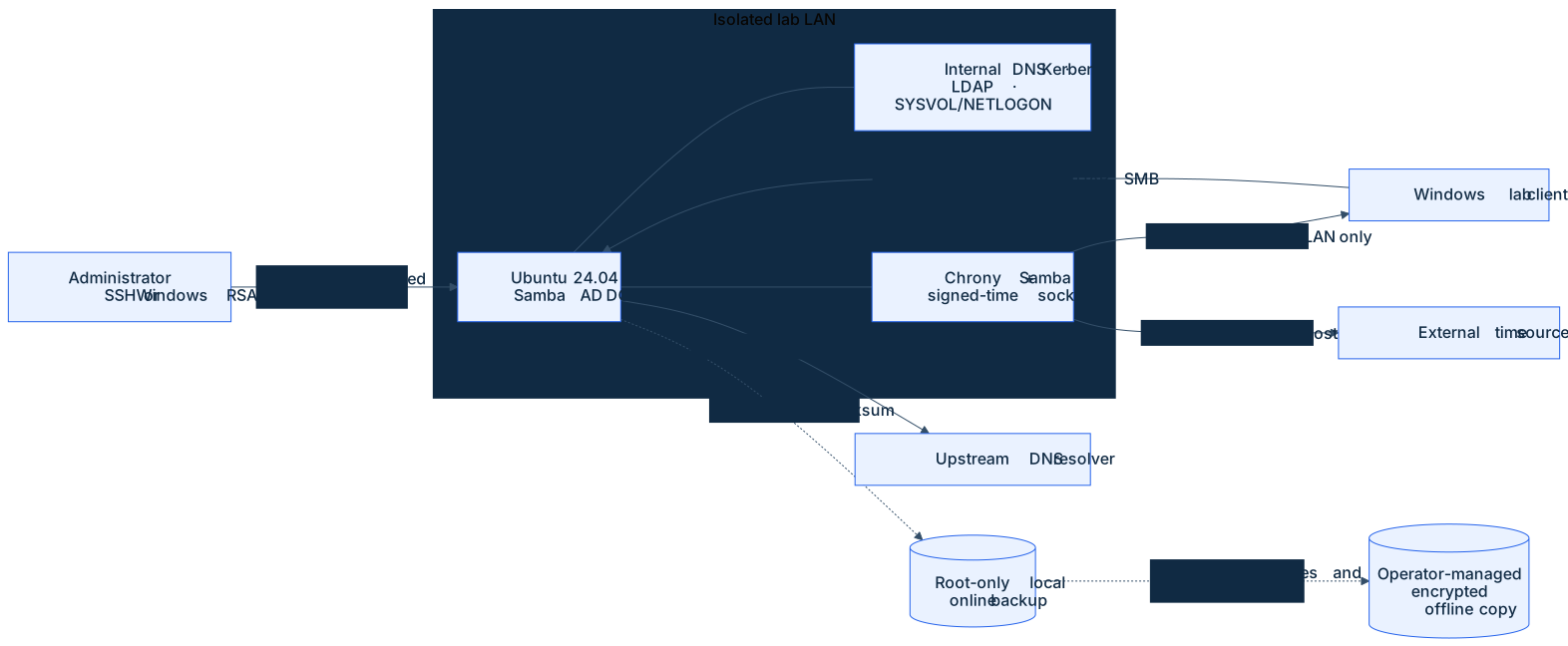
03 / Implementation
Ordered stages, explicit operator gates.
10-prereqs → 20-install → 30-provision
→ 40-dns-forwarder → 45-time-sync
→ 50-verify → 60-create-objects (optional)
→ 70-backup (optional)
Configuration is parsed as allow-listed data instead of sourced as root-executable shell. Provisioning skips matching state and refuses a realm or domain mismatch. Credentials stay in interactive prompts rather than configuration or process arguments.
04 / Decisions & trade-offs
Safety comes before unattended execution.
- Samba internal DNS keeps the first-DC lab focused; BIND9 DLZ and multi-DC replication remain outside scope.
- DNS activation restores resolver, service and Samba state when activation fails.
- No automatic firewall changes avoids locking operators out of an unknown host; the runbook carries the allow-list.
- Teardown stays documented because destroying the only DC is irreversible and environment-dependent.
05 / Validation
Static confidence is not a working domain.
- Repository CI validates syntax and guardsBash syntax, parser tests, documentation links, workflow structure, ShellCheck and secret patterns can be checked offline.CI validated
- Runtime authentication is pendingNo source evidence shows live provisioning, DNS/Kerberos service behavior, a Windows join or Group Policy processing.Runtime pending
- Recovery is designed, not demonstratedThe runbook requires isolated restore plus database, SYSVOL, DNS, Kerberos, share, signed-time and client tests.Restore and teardown pending
06 / Current status
Lab: CI validated; runtime validation pending.
Automation, verification logic and recovery runbooks are authored. A dedicated disposable host, isolated client, live service checks, restore drill and careful teardown are still required before any runtime or recovery claim.
07 / What I learned
Identity is a chain of dependencies.
DNS discovery, synchronized time and credential handling matter as much as the directory daemon. State-aware reruns and recovery evidence belong in the design from the first provisioning step.