Dependency-light by design
Semantic HTML, shared CSS and vanilla JavaScript are checked for local links, headings, metadata, meta CSP consistency and syntax before delivery.
Infrastructure / Delivery & labs
A view of how this portfolio ships and how the personal Azure and identity labs are designed. Each diagram names what is deployed, what is authored and what still needs runtime evidence.
01 / Portfolio delivery
GitHub Pages deployed; verified 9 September 2026. GitHub Actions validates the generated surface, stages only public files and uploads a Pages artifact before the deployment job can publish it.
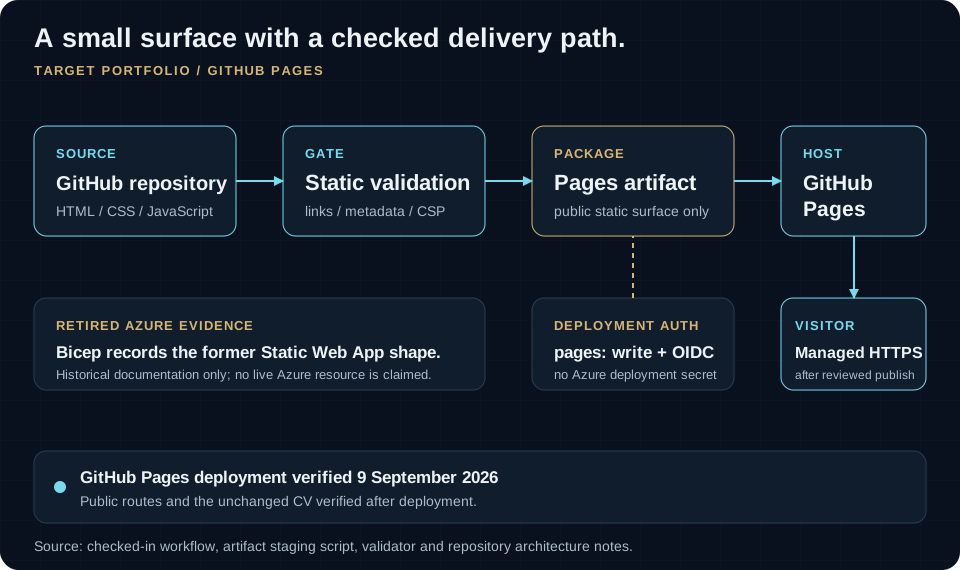
yossefseit.github.io. The deployment job uses pages: write and a short-lived OIDC token; it stores no Azure credential. The public routes and byte-identical CV were verified on 9 September 2026. Open successful deployment ↗Semantic HTML, shared CSS and vanilla JavaScript are checked for local links, headings, metadata, meta CSP consistency and syntax before delivery.
The checked-in workflow packages only the public static surface. A github-pages environment receives the artifact after a validated main update.
infra/main.bicep records the former Static Web App shape for review. It is not part of the current delivery path and no live Azure resource is claimed.
02 / Personal Azure networking lab
Lab: CI validated; Azure deployment pending. A private-by-default Bicep design with three VNets, explicit peering, isolated spokes and Blob access through Private Link.
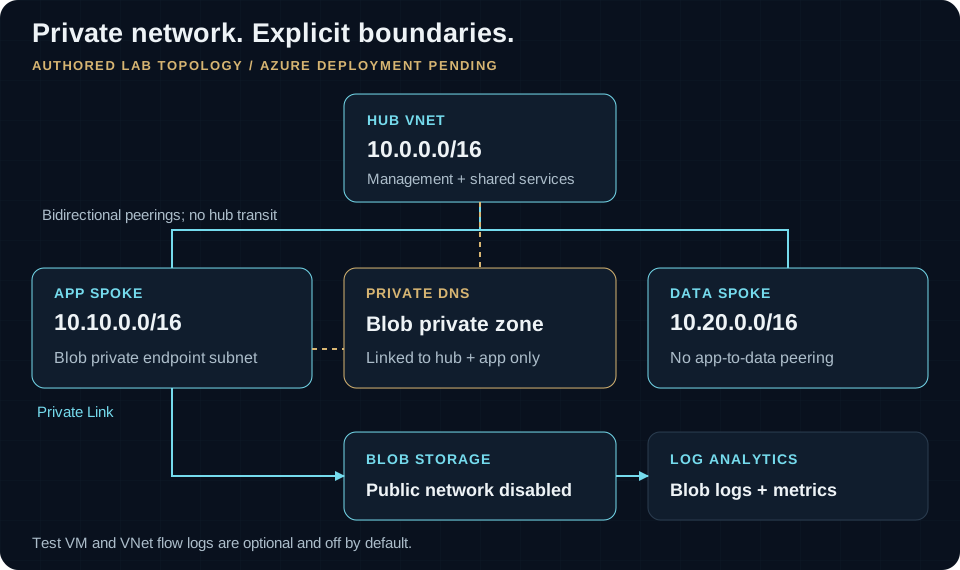
Hub 10.0.0.0/16, app 10.10.0.0/16 and data 10.20.0.0/16, with NSGs, ASGs and cross-spoke blackhole routes.
The Blob private endpoint sits in the app spoke. The private DNS zone links to the hub and app only; public network access is disabled.
The private test VM and VNet flow logs default to disabled. A live connectivity and isolation run remains pending.
03 / Personal Azure governance lab
Lab: CI validated; Azure deployment pending. Subscription-scoped Bicep for audit-first policy, bounded access, cost notifications and a protected governance resource group.
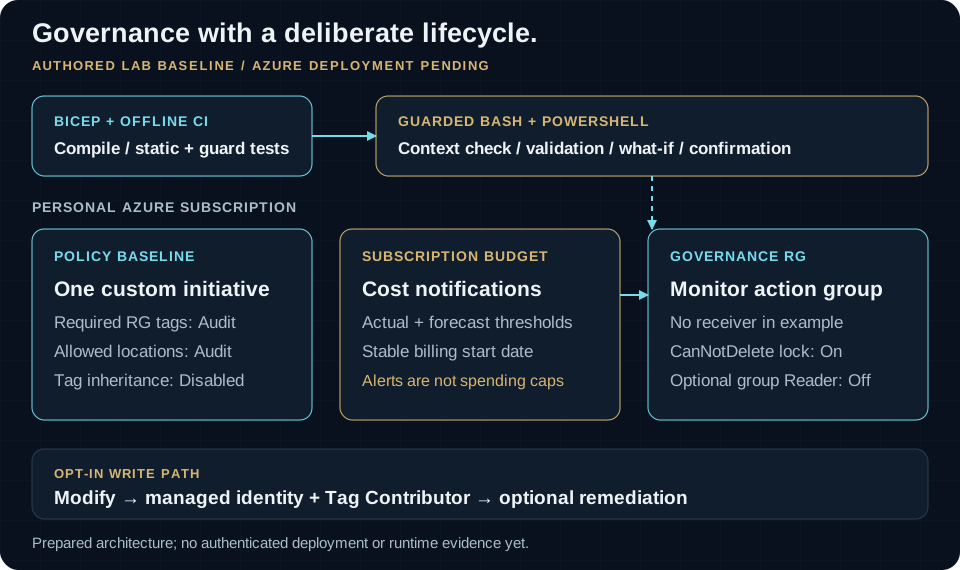
Three custom definitions form one initiative. Required resource-group tags and allowed locations default to Audit; tag inheritance starts Disabled.
A subscription budget routes notifications to an action group. The example deliberately contains no personal receiver.
Scripts check subscription context, review what-if, require exact confirmation and use a manifest to guard deletion.
04 / Personal identity lab
Lab: CI validated; runtime validation pending. Guarded Ubuntu automation for a first domain controller, DNS-based discovery, Kerberos, signed time, verification and recovery planning.
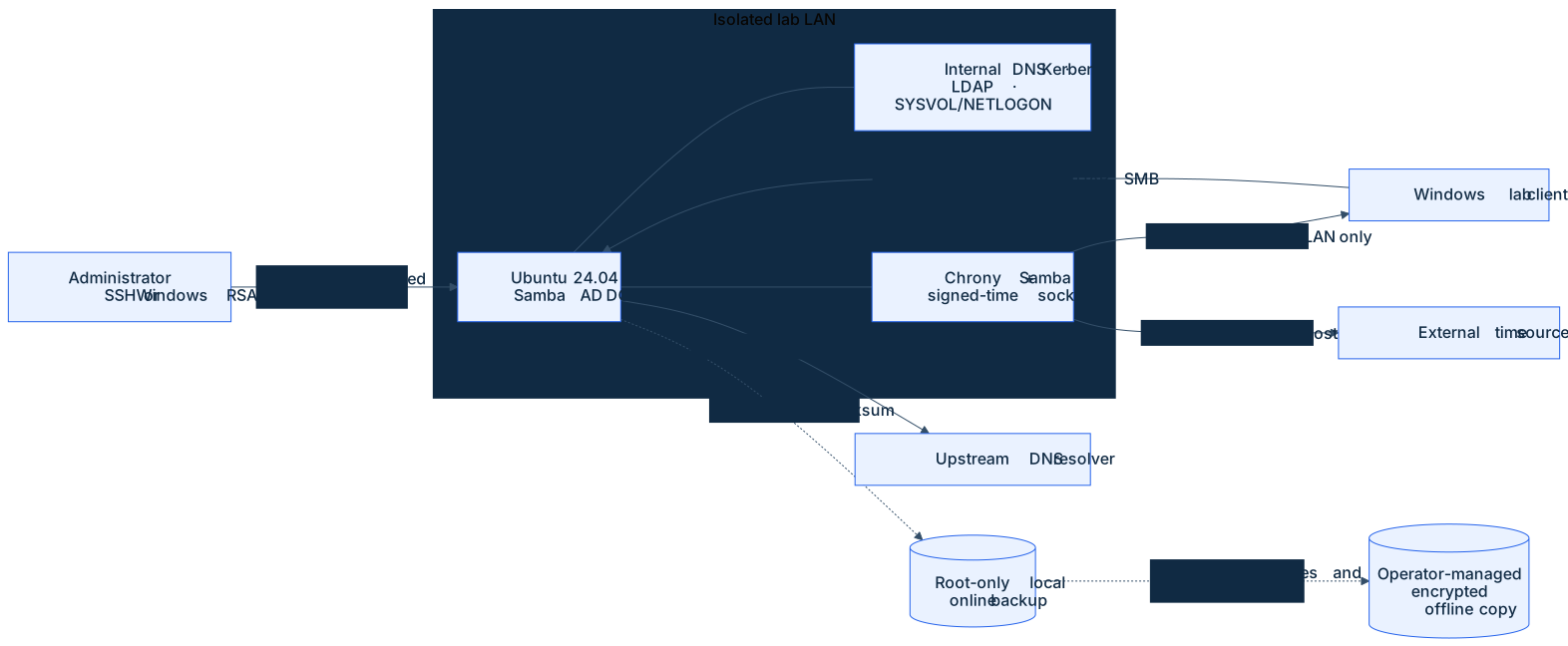
All lab diagrams describe Yossef’s personal portfolio work. They do not represent Electrolux, Aegis, El Mostafa or any employer system.